Getting Started: Frequently Asked Questions
How much does it cost to get started in the RC hobby?
Ready-to-run RC cars start at around €100, while a good hobby-grade car typically costs €150–300. RC aircraft are similarly priced: a beginner plane with gyro stabilisation costs around €120–170. For a kit, allow approximately another €100 for radio equipment, an electronic speed controller and paint. A second battery is often the first unexpected extra expense, so it is worth budgeting for one from the start.
What else do I need besides the model?
That depends on what is included in the box. A ready-to-run RC car often only needs batteries for the transmitter, but the drive battery and charger are not always included. A kit requires radio equipment, an electronic speed controller, a battery, a charger and body paint. Always check the product description for the included equipment—and ask us if you are unsure.
What age is suitable for starting the hobby?
Primary school children can enjoy a simple RC car with an adult taking care of battery charging. RC aircraft and drones require more patience and space. For scale model kits, check the recommended age on the box. Some snap-fit kits that do not require glue are suitable for children aged around five and up.
RC Cars: Frequently Asked Questions
What is the fastest RC car on the market?
The fastest production RC cars can exceed 100 km/h using brushless motors and multi-cell battery packs. These cars require a safe, open driving area and are not suitable for beginners. Top speed also depends on the battery and gearing, so the same car can reach different speeds with different setups.
What is the best all-round RC car?
A 1/10-scale, four-wheel-drive brushless car is often a strong all-round choice: it offers plenty of speed, handles rough terrain and has spare parts available for years. Spare parts availability is just as important as the car’s features.
What RC car is suitable for a beginner?
For a first car, choose a ready-to-run brushed model or a moderately powered brushless model in 1/16 to 1/10 scale. A monster truck is a versatile choice because it can handle grass, gravel and uneven terrain. An overly powerful first car is difficult to control and more likely to suffer damage.
What is the most durable RC car for a child?
A smaller monster truck or crawler with good ground clearance, a flexible body and straightforward mechanics is usually a durable choice. Spare parts availability is essential: parts can break during use, and a repairable car can keep going for years. Avoid very fast models.
Should I choose an electric or combustion-powered RC car?
An electric car is usually the best choice today: it is quiet, starts at the push of a button and does not require fuel handling or engine tuning. Combustion-powered cars offer their own distinctive sound and can be refuelled for continued driving, but require more maintenance and a suitable driving location. Electric power is the recommended starting point for beginners.
What is the difference between brushed and brushless motors?
A brushed motor is affordable, offers smooth control and is well suited to learning and crawling. Its carbon brushes wear over time, so the motor is a wear item. A brushless motor is generally more efficient, can deliver more power and has no brushes to replace. Depending on the setup, it can provide longer runtimes or higher speeds. A brushless motor requires a compatible brushless electronic speed controller.
What do 3300 kV and 12T mean in a motor’s name?
These figures describe motor characteristics rather than directly measuring power. The T rating means winding turns: within a comparable motor range, fewer turns generally mean higher speed, while more turns generally mean lower speed.
The kV rating indicates a motor’s approximate unloaded revolutions per minute per volt: a higher kV rating means higher unloaded speed at the same voltage. Brushless racing motors also use turn ratings, such as 13.5T or 17.5T. Actual performance depends on the complete motor, battery and gearing setup.
How long can an RC car run on one battery?
A typical runtime is 15–25 minutes, depending on battery capacity and driving style. A powerful brushless setup driven continuously at full throttle can reduce runtime to less than ten minutes. A spare battery is a popular purchase after the first driving session.
What is the difference between 2WD and 4WD RC cars?
Two-wheel-drive cars are simpler, lighter and generally less expensive to maintain. They also help you learn throttle control. Four-wheel-drive cars offer more traction and are easier to control, especially on loose or wet surfaces. For beginners, 4WD is more forgiving, while 2WD offers an enjoyable challenge as skills improve.
What does 1/10 scale mean?
The scale indicates how much smaller the model is than its full-size counterpart. A common RC car scale is 1/10: these cars are typically around 40–50 cm long, have good spare parts support and work well both outdoors and on a track. Models in 1/16, 1/18 and 1/24 scale are smaller and less expensive but struggle more on rough terrain. Models in 1/8 scale and larger require more space and are generally built for more demanding use.
What does RTR mean—is a battery included?
RTR means Ready-to-Run: the car is assembled and set up at the factory. However, RTR does not automatically mean that a battery and charger are included. Some models include both, while others require them separately. Always read the product description to see what else you need. Transmitter batteries are also usually required.
Can I drive an RC car in wet conditions or snow?
Yes, provided the model is designed for those conditions. WP in a product name usually refers to waterproof equipment, but you should always check the manufacturer’s instructions and limitations. A waterproof rating does not automatically mean the car can be submerged. After driving in wet conditions, dry the car and remove trapped water. Wet grass, snow and puddles can damage unprotected electronics.
What is the difference between a crawler and a monster truck?
A crawler is designed for slow, technical driving over rocks, roots and obstacles. The focus is on making progress and controlling the car rather than speed. A monster truck is a faster all-round vehicle for gravel, grass and rough terrain. Choose a crawler for woodland trails and rocks, or a monster truck for more varied driving.
Why did my electronic speed controller burn out?
One common cause is an overloaded or underspecified electronic speed controller (ESC). Its current rating indicates how much electrical load it can handle. An unsuitable motor, excessive vehicle weight or oversized tyres can cause overheating and failure. Another cause is excessive battery voltage: the ESC’s supported cell count, such as 2–3S, must never be exceeded. Moisture can also damage an unprotected ESC.
RC Aircraft: Frequently Asked Questions
What is the best RC aircraft for a beginner?
Choose a high-wing trainer with generous wing dihedral and gyro stabilisation. A foam airframe is useful because it can withstand minor knocks and can often be repaired with suitable glue. A wingspan of around 500–1,200 mm is a practical starting point. A warbird is generally not a good first aircraft, however appealing it looks.
What is the fastest RC aircraft?
EDF jets and purpose-built pylon racing aircraft are among the fastest powered RC models, with speeds well above 200 km/h. They require experience, an open flying field and quick reactions. An ordinary sport model typically flies at around 40–80 km/h, which is more than enough for enjoyable flying.
What do RTF, PNP, ARF and Kit mean?
RTF (Ready-to-Fly) usually includes the aircraft, transmitter, receiver, battery and charger. Transmitter batteries may be required separately, and package contents vary, so always check the product description.
PNP (Plug-and-Play) includes the motor, ESC and servos. You normally need to add a transmitter, receiver, battery and charger.
ARF (Almost-Ready-to-Fly) provides a largely assembled airframe. Radio equipment, power system, battery and charger are generally purchased separately; exact contents vary.
Kit means a building kit with more individual parts and substantially more assembly work.
What is a gyro, and do I need one?
A gyro-based stabilisation system automatically helps correct unwanted movement. Systems with a self-levelling mode can also return the aircraft towards level flight when you release the controls. Stabilisation is particularly helpful for beginners and makes learning easier. On many models, it can be reduced or switched off as your skills improve.
Why does my RC aircraft struggle in the wind?
Small aircraft with wingspans of around 400–500 mm are light and easily affected by wind. They are best flown in calm conditions. If you want more opportunities to fly, an 800–1,200 mm model generally handles light winds better, flies more steadily and is easier to see at a distance.
What does 10×5 mean on a propeller?
The first number is the diameter in inches. The second is the pitch: the theoretical distance the propeller would advance in one revolution. A larger diameter generally favours thrust, while greater pitch can favour speed. An oversized or excessively high-pitch propeller can overload the motor and ESC, so use the sizes recommended by the manufacturer.
How long can an RC aircraft fly on one battery?
A small foam aircraft typically flies for around 8–12 minutes. A powered glider can stay airborne longer because the motor is mainly used for climbing. Two spare batteries can make a flying session much more enjoyable and are a popular purchase after the first day.
Can a damaged foam aircraft be repaired?
Yes—repairability is one of the main advantages of a foam beginner aircraft. EPO and EPP foam can be repaired with suitable adhesive, and a well-made repair can be durable. Propellers are more easily damaged: one hard landing can be enough, so it is worth having a spare.
Drones: Frequently Asked Questions
What is the difference between an RC aircraft and a drone?
In this context, an RC aircraft means a fixed-wing model that flies forwards using lift generated by its wings. A drone means a multirotor that takes off vertically and can hover. Fixed-wing models generally offer longer flight times, while multirotors can operate in smaller spaces and are well suited to photography.
Do I need to register a drone?
Registration requirements depend on factors including the aircraft’s weight and whether it has a camera. The rules apply across the EU, and in Finland they are administered by the Finnish Transport and Communications Agency, Traficom. Check the current requirements and operator registration instructions at droneinfo.fi before your first flight. These rules also cover RC model aircraft.
Where can I fly a drone?
Restrictions apply around airports and in certain other areas. There are also rules on flight height and maintaining visual contact with the aircraft. Check the current rules and geographical zones at droneinfo.fi and its linked mapping services. Respect other people’s privacy when flying and filming.
What drone is suitable for a beginner?
A small indoor drone without a camera is an affordable way to learn the controls. Check the requirements for the particular model before use. Once you are comfortable flying, a camera-equipped model can be a natural next step. Start with an inexpensive model, as bumps and crashes are common while learning.
What is an FPV drone?
FPV means First-Person View: video from the drone’s onboard camera is transmitted directly to goggles or a screen. It creates the feeling of being on board the aircraft. FPV flying can be spectacular but takes practice. Goggles, cameras, motors and small batteries are also available separately.
Why does my drone only fly for 5–10 minutes?
A multirotor relies entirely on motor thrust to stay airborne, unlike a fixed-wing aircraft supported by its wings. Small drones therefore often have short flight times; this does not necessarily indicate a fault. Spare batteries let you extend the session across several flights.
Can I fly a drone indoors?
Small drones with propeller guards can be flown indoors and are useful for learning. Larger models generate strong airflow and are unsuitable for confined spaces. Allow plenty of room and keep people and pets clear of the flying area.
Can I fly a drone in freezing temperatures?
Only if the manufacturer permits operation at the temperature in question. Cold batteries deliver less power and their voltage can fall more quickly, reducing flight time. Keep batteries warm before use and land earlier than you would in summer. Also consider condensation when bringing cold equipment indoors.
RC Boats: Frequently Asked Questions
What is the best RC boat for a beginner?
A slower tugboat or workboat is a good first model: it is stable, easy to steer and less likely to get away from you. Fast racing boats are exciting but require a large, calm stretch of water. Always check that the boat is adequately sealed and plan how to retrieve it if the motor stops.
What is the fastest RC boat?
High-performance brushless racing boats can exceed 70 km/h. They require experience and a sheltered, open stretch of water, along with a way to retrieve a stopped boat. A slower model is recommended for beginners.
Scale Models: Frequently Asked Questions
What is the best scale model kit for a beginner?
A gift set or starter kit with a manageable number of parts and included paints and glue makes a good first project. Snap-fit kits without glue are also suitable for children. Choose a scale with parts large enough to handle comfortably: 1/48 aircraft and 1/35 military vehicles are generally easier to work with than their 1/72 equivalents.
What do I need for my first scale model?
Four basic tools provide a good starting point: thin plastic cement, sprue cutters, a hobby knife with spare blades and sanding sticks. You can add more tools as the hobby develops. Some kits include paints and glue—check the product description.
What are the best glue and paint for scale models?
For suitable plastic kits, use plastic cement, which bonds parts by softening and welding the plastic together. Thin liquid cement is a popular choice: position the parts and apply it to the joint, allowing capillary action to draw it into the gap. Acrylic paints are an accessible starting point, and brush painting works well for your first models. An airbrush can be added later.
Why did the glue make my windows cloudy?
Ordinary plastic cement can damage clear parts. Canopies, windscreens and lenses should be attached using adhesive designed for clear parts, which dries clear without fogging the plastic. Using the wrong glue is a common beginner mistake, and a suitable clear-parts adhesive typically costs less than €6.
How do I glue resin and metal parts?
Plastic cement does not bond resin, photo-etched parts or metal. These generally require cyanoacrylate adhesive, also known as super glue. Wash resin parts with dishwashing liquid before painting to remove mould-release residue that could prevent paint adhesion. Remove parts from their casting blocks by carefully sawing or cutting, rather than bending them off.
How do I apply decals?
Soak a waterslide decal in warm water until it releases from its backing, then slide it into position. Decals may not settle naturally into panel lines or over curved surfaces, and air trapped beneath the film can cause a silvery appearance. Decal setting solution helps adhesion, while decal softener allows the film to conform to surface details for a painted-on appearance.
Can I build a scale model without painting it?
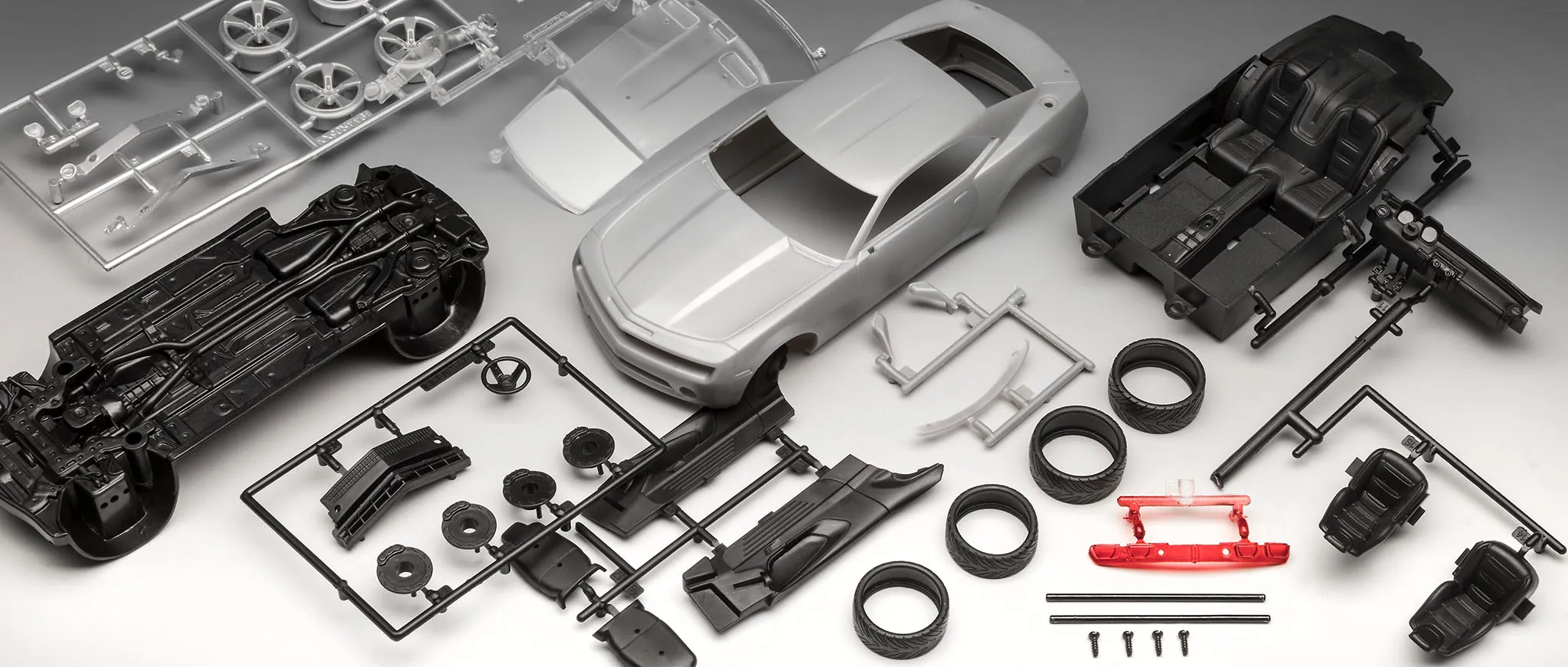
Yes. Some kits are designed to be assembled without glue or paint, using pre-coloured snap-fit parts. Look for terms such as Quick Build, Easy-Click or Clic Loc in the product name. Bandai Star Wars kits can also be assembled without glue.
What does scale mean in a model kit?
The scale indicates how much smaller the model is than the full-size subject. Common scales include 1/72 and 1/48 for aircraft, 1/35 for military vehicles, 1/24 for cars and 1/12 for motorcycles. Choosing a consistent scale helps models fit together visually in a collection.
Why is a symbol on the box covered up?
This is particularly common with Second World War aircraft and military vehicles. Certain historical symbols are restricted in some European countries, so they may be covered or omitted on boxes, instructions or decal sheets. We source our model kits from European distributors, and manufacturers or distributors do not provide replacements solely because these symbols have been covered or omitted.
Batteries, Chargers and Spare Parts
What battery and charger should I choose?
Battery selection depends on cell count, capacity in mAh, connector type and compatibility with your model. Physical dimensions also matter. A good-quality smart charger is a worthwhile investment: choose one that supports your battery chemistry, balances LiPo cells and provides a storage-charge function. Always verify the settings before charging. Charging current affects charging time: a 5,000 mAh battery takes approximately an hour at 5 A, while a 2 A charge takes more than two hours. Follow the battery manufacturer’s permitted charge rate.
What is the difference between LiPo and NiMH batteries?
NiMH batteries are generally more forgiving and require less careful storage management. They are often included in ready-to-run packages. LiPo batteries offer a good power-to-weight ratio but require more careful handling and should not be stored fully charged or deeply discharged. Always check that your model supports LiPo batteries before switching.
How do I store a LiPo battery safely?
Use a suitable fire-resistant charging bag and follow the battery and charger instructions. Store the battery at its recommended storage charge rather than fully charged or depleted; a compatible smart charger provides a storage mode. Never charge a damaged or swollen battery, and never leave charging unattended. A charging bag is an additional precaution, not a guarantee against fire.
What connector does my RC car use?
There is no single industry standard. Common types include XT60, Deans or T-plug, Tamiya, XT90, EC5 and JST. Traxxas also uses its own iD connector system. Adapters can connect some compatible combinations, but a matching connector alone does not make a battery suitable: voltage, polarity, current capacity and battery chemistry must also be correct. If you are unsure which connector you have, send us a photo and we can help identify it.
Where can I get spare parts for RC cars and aircraft?
We stock a wide selection of spare parts for popular brands, including driveshafts, suspension arms, bodies, tyres, gears and electronics. Parts are typically available for years after a model’s release. Tell us the car or aircraft model and, ideally, the part number from its manual so we can help find the correct replacement. Spare parts are also often available for older radio equipment and servos.
Are spare parts available for airbrushes and compressors?
Yes. Needles and nozzles are wear items, and damage or wear can cause spray-pattern problems. Cleaning, paint consistency and air pressure are also worth checking. Tell us your airbrush model and needle size so we can help find a suitable replacement. Service kits are also available for some compressors.